Kaudi Pandit Project Update 2 - Introduction to the Board Game
Disclaimer: Region to region, family to family, instance to instance, there can be variances to the game. It is configurable for number of pieces per player, number of cowries, board-size and number of players, not to mention various run-time rules and interpretation of cowrie states. For this description, I’ve discussed only the full version of the game as I’ve played it before. This version henceforth will be considered the standard game in this project.
Game Definition
In this post I write down the full description and rules of the standard game.
The goal behind this post is two fold:
- To explain the game to the audience,
- To thoroughly list out what is a very complex rule-set, so that it can be used as a template for coding.
Game Overview
The game is played by 4 players sitting at each edge of the board. The board is a square shaped 7x7 grid. Navigational guide lines (here in red) are also provided to assist with movement.
Each player starts the game with 6 pieces in their home square which is the central square in the bottom row from their point of view.
The goal of the game is to move these 6 pieces through the board on the legal path until they reach the final central square. The player to move their 6 pieces to the central square first, also known as “sending them to sleep”, wins. The game can continue without the winning players to find the second, third and last player.
The board and path
Turn
Players take turns in an anti-clockwise fashion around the board. Each turn allows the player to throw the set of 6 kaudis. The outcome is decided by the number of upturned kaudis (with their flat or open side up).
- If all kaudis land with curved-side up, the outcome value is actually 12 instead of 0.
- Kaudi throw outcomes of 6 or 12 (all up or all down) entitle the player to roll again, and use the cumulative total for their turn.
- The rare 3 consecutive throws of 6 or 12 within the same turn result in a total outcome of 0 and the player misses their turn.
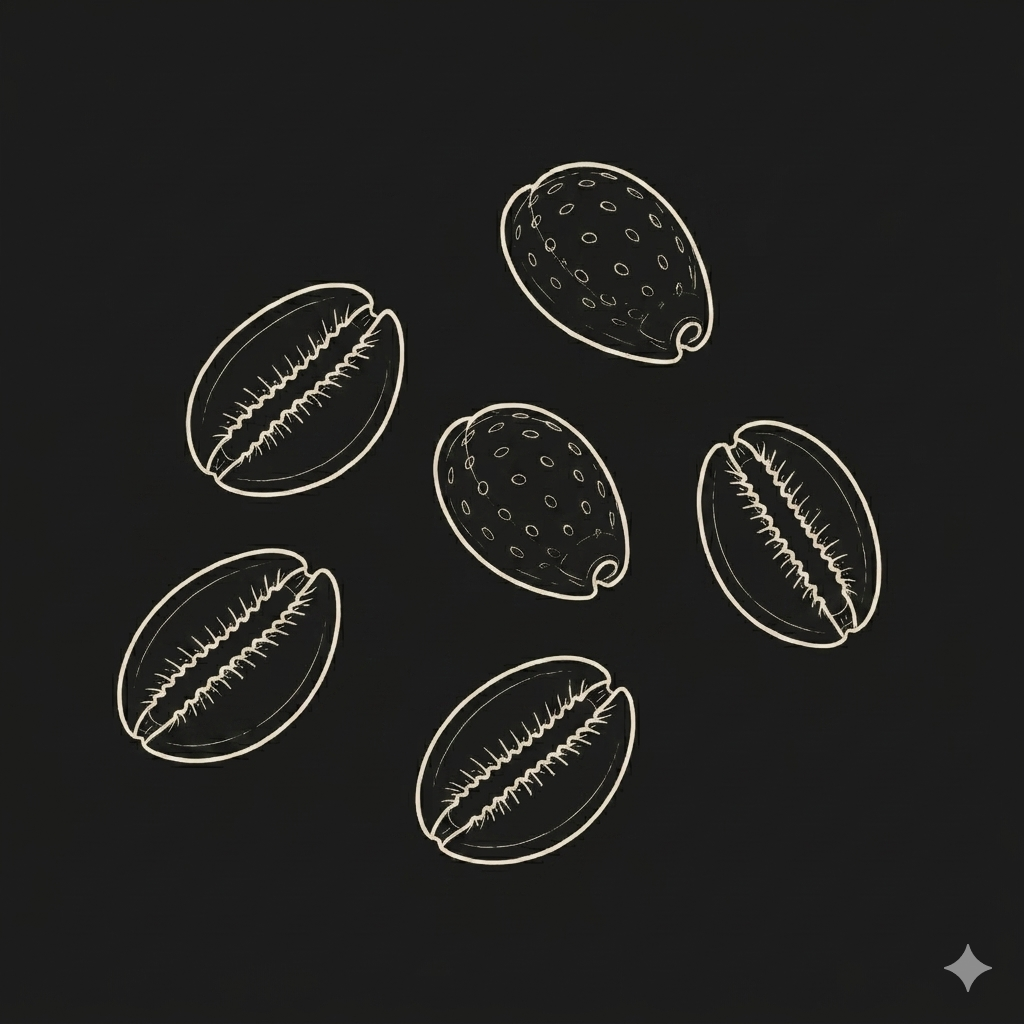
The outcome value of the throw must then be used to move a piece by an equal number of squares (steps) as the outcome value. For turns with multiple throws because of 6 and 12, each individual throw’s value can be used separately on different pieces or used cumulatively on one piece.
Piece Tuples
Pieces can be variably moved as piece-tuples of any size (single through to sextuplet).
A tuple is joined when the pieces are moved together for the first time. Tuples cannot be joined from the player’s home square, only from any other subsequent square in the path. Tuples can be broken back into their constituents or into smaller tuples but only from squares marked with a cross.
The kaudi throw outcome must divide fully into the size of the tuple for it to be deemed usable — for example, a roll of 6 cannot be used to move a quad or quint but can be used to move a single piece 6 steps, a twin for 3 steps, a triplet for 2 steps or a sextuplet for a single step. If a player has no usable moves under this arrangement (e.g. if they only have a twin-tuple and they roll a 3), they must pass their turn without moving the pieces.
Combat
Players can use their pieces to kill other players’ pieces and send them back to the player’s home square, thus delaying the other players’ finish and increasing their own chance of winning. Combat rules are subtle and complex when it comes to piece-tuples.
Two-player interactions
- A player’s tuple landing on another player’s tuple of the same or lesser size will instantly kill the existing tuple.
- A player’s tuple landing on another player’s tuple of greater size will neither die nor kill the opponent tuple. However, if the larger tuple is moved off the square before the smaller one, the smaller will die upon the larger’s exit.
Three or Four player interactions
Coming soon.